
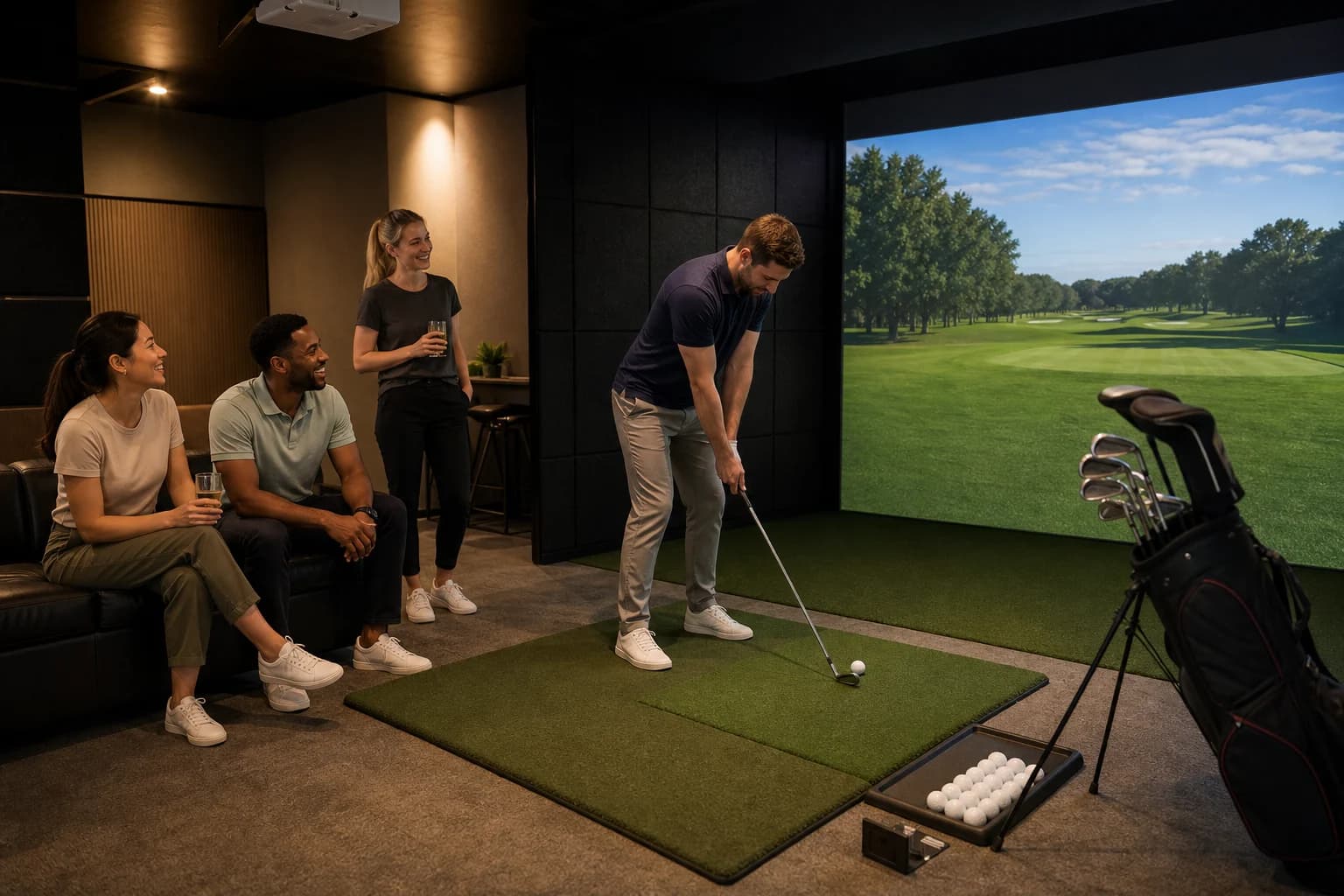
Most golf simulator bays work best with one to four active players, even when the venue allows five, six, or eight people in the space. Four is the practical ceiling for a normal virtual round: everyone gets enough swings, the bay stays easier to manage, and one late player does not derail the whole booking.
The catch is that “allowed in the bay” and “able to finish 18 holes comfortably” are not the same thing. Some venues cap a session at four or five golfers, while social venues may permit six or eight. Always check the exact location before you pay.
Quick answer: the best group size for a golf simulator
| Group size | Best use | What to book |
|---|---|---|
| 1 player | Practice, club gapping, fast solo round | 60–90 minutes |
| 2 players | Date night, practice, 9 or 18 holes | 90 minutes to 2 hours |
| 3–4 players | Social round, scramble, closest-to-pin games | 2–4 hours, depending on format |
| 5–6 players | Casual games, party, team scramble | Longer session or 2 bays |
| 7+ players | Event, work outing, birthday group | Multiple adjacent bays or an event package |
Those are planning ranges, not universal rules. Player speed, mulligans, putting settings, food orders, and the game format all change the clock. A venue’s posted capacity still controls.
If you want the shortest recommendation: book one bay for up to four golfers; book two bays for five or more if the group wants meaningful playing time.
How many players do venues actually allow?
Current venue policies show why there is no single national answer:
- Perfect Shot Indoor Golf recommends no more than four golfers and limits a simulator session to five players.
- Five Iron Golf's simulator booking flow says an individual simulator can fit up to six people.
- Back 9 Social allows up to eight players in a bay, but recommends a second bay or VIP setup for larger groups.
That range—four to eight—is a useful warning. The physical room, seating, software, venue concept, and safety layout matter as much as the simulator hardware.
A training studio may intentionally keep a bay quiet and uncrowded. A golf bar may have lounge seating designed for spectators. A self-service studio may set a lower limit because no employee is constantly supervising the space.
So do not assume that a six-player limit at one business applies to the next venue. Use GolfSimMap search to compare nearby options, then open the venue’s booking page or call to confirm the current rule.
Capacity is not the same as pace of play
This is the mistake groups make most often: they see “up to six” and assume six people can play a full 18-hole round in a short booking.
Every extra golfer adds shots, setup time, club changes, and conversation. Indoor golf removes walking and ball searching, but it does not remove turns.
Two current venue examples give a realistic starting point:
- Perfect Shot publishes an estimate of roughly one hour per player for 18 holes, from one hour for a solo golfer to four hours for four golfers.
- Back 9 Social also estimates about one hour per player for 18 holes and notes that eating, drinking, and socializing can slow a group further.
Those estimates are conservative by design. A quick twosome using automatic putting may finish faster. A mixed-skill foursome taking mulligans and ordering food may need every minute.
For two golfers, Golf Hour recommends at least 1.5 hours for groups and a minimum of two hours when two players want to complete 18 holes. The lesson is simple: choose the activity first, then choose the booking length.
What one bay can handle by group size
One player
Solo is the most efficient way to practice indoors. You can work through a structured session, record carry numbers, or play a quick virtual round without waiting for another turn.
If improvement is the goal, use our 60-minute golf simulator practice plan instead of racing through 18 holes. A quiet training-focused venue may fit better than a busy sports bar.
Two players
Two is the easiest social booking. Both golfers get frequent swings, and there is still time to adjust settings or explain the system to a beginner.
For a full round, two hours is a sensible baseline. Book less if you are playing nine holes, practicing, or choosing quick target games.
Three or four players
Three to four is the sweet spot for a normal group round. It feels social without leaving each person on the couch for long stretches.
But a foursome should decide what matters before arrival:
- A real 18-hole score: reserve enough time and keep mulligans under control.
- A casual night out: play nine holes or shorter challenges.
- Mixed skill levels: use a scramble so beginners are not forced to finish every hole alone.
- Practice: split into two bays if everyone wants useful shot data.
Four golfers trying to complete 18 holes in one hour will almost always feel rushed. Four golfers playing closest-to-the-pin for an hour can have a great session.
Five or six players
Five or six people can fit at many social venues, but one bay starts becoming a party space more than a full-round setup.
That is fine—if it is what you want. Use team games, a scramble, long-drive contests, or a short par-3 course. If everyone expects to play their own ball for 18 holes, two adjacent bays are the better fit.
Before booking, confirm whether the venue counts spectators toward the bay limit. Someone who “just wants to watch” still occupies space and may still count.
Seven or more players
For seven or more, stop thinking in terms of a single bay. Ask for two adjacent simulators, a private room, or an event package.
Side-by-side bays keep the group connected while doubling the number of people who can play. They also make it easier to run a small tournament: split into teams, use the same course or target challenge, then compare scores.
GolfSimMap has dedicated pages for large-group simulator venues and corporate group indoor golf. Policies and event capacity still vary, so confirm the exact setup with the venue.
How much simulator time should your group book?
Use this decision rule:
For a full 18-hole round, start with roughly one hour per active golfer. For a social game or team format, start with 60–90 minutes and ask the venue what works best on its system.
Then adjust for the group:
- Add time when several players are new to simulator controls.
- Add time if everyone wants a separate score.
- Add time for food, drinks, breaks, or frequent mulligans.
- Reduce the number of holes when the group is larger than four.
- Use automatic putting or a generous gimme setting if the venue allows it.
Do not book based only on the maximum capacity shown in the reservation widget. If the system lets you select six people, that tells you the group may enter the bay—not that six individual rounds fit into 90 minutes.
Better formats for bigger simulator groups
The right game can rescue a crowded booking.
Team scramble
Split the group into teams. Everyone hits, each team chooses its best shot, and the team continues from there. A scramble cuts down bad-shot recovery time and keeps beginners involved.
Closest to the pin
Pick one par 3 or target distance and rotate through the group. This works well when some guests are mostly there to socialize.
Long drive
Fast, simple, and easy to understand. Use it late in the booking, after everyone is warm, rather than asking cold golfers to swing as hard as possible.
Nine holes instead of 18
Nine holes gives a group time to learn the controls without turning the final holes into a sprint. It is often the best answer for a three- or four-player booking under two hours.
Two-bay match
For a larger group, book adjacent bays and put one team in each. Confirm both bays can run the same course or game settings if head-to-head scoring matters.
The safety rule every group should follow
Only one person should be in the hitting area, and everyone else should stay clearly behind the player and the club’s swing arc.
Back 9 Social’s published rules, for example, require other players to remain behind the simulator hardware while someone is hitting. The exact boundary will look different at each venue, so follow staff instructions and posted markings.
Drinks, phones, spare clubs, and children should stay out of the hitting zone. If kids are joining, read our parent booking checklist for golf simulators and verify supervision or evening rules for the location.
Mixed right- and left-handed groups should also confirm that the bay supports easy switching. Our left-handed simulator guide explains what to ask about clearance and hardware placement.
What to ask before booking a group bay
Send the venue these questions before paying:
- What is the maximum number of players and total guests per bay?
- Do spectators count toward that limit?
- How much time do you recommend for our group and chosen game?
- Can we reserve adjacent bays?
- Are rental clubs available for adults, kids, and left-handed golfers?
- Can we use a scramble, automatic putting, or target games?
- Are food and drinks allowed at the bay?
- Are there age, supervision, waiver, or evening restrictions?
- How early should the group arrive?
- What is the late-arrival and cancellation policy?
If the answers are vague, book more time or choose the extra bay. A slightly roomier setup is usually better than paying for a crowded session where half the group barely swings.
Find the right simulator for your group
The practical answer is not “how many people can fit?” It is “how many people can do what we want without feeling rushed?”
For most groups, one to four active golfers per bay is the best fit. Five or six works for short games and parties. Seven or more usually calls for multiple bays or an event setup.
Start with indoor golf near you, or browse simulator venues in California, Texas, and New York. Confirm the current capacity and recommended reservation length with the exact venue before you book.
Frequently asked questions
Can six people play on one golf simulator?
Sometimes. Five Iron Golf's booking flow allows up to six people on an individual simulator, while other venues set lower or higher limits. Six people are better suited to a scramble, target games, or a longer booking than six separate 18-hole scores. Check the specific venue policy.
How many people can play 18 holes on a simulator in two hours?
Two golfers are the safest planning assumption for a complete 18-hole round in two hours. A fast threesome may finish with quick settings, while a social group may not. Venue estimates commonly start around one hour per player for 18 holes.
Is golf simulator pricing per person or per bay?
Many venues price standard sessions by the bay and hour, but not all do. Events, memberships, club rentals, and premium rooms may use different pricing. Read the checkout details before comparing the per-person cost.
Do spectators count toward the simulator bay limit?
They may. Some venues distinguish active players from total guests, while others cap everyone inside the bay. Ask the venue before bringing non-playing friends, children, or coworkers.
Should a group of eight book one or two simulator bays?
Two bays are usually the better choice for eight people. Although some social venues allow eight players in one bay, adjacent bays give everyone more swings, reduce waiting, and make a team competition easier to run.
Sources checked
Related Articles
Do Golf Simulators Have Clubs? Rental Guide
Many indoor golf venues offer club rentals, but availability, fees, handedness, and set makeup vary. Use this checklist before you book.
ReadCan You Play a Golf Simulator Alone? Solo Guide
Can you play a golf simulator alone? Compare solo rates, self-service access, booking time, and a focused 60-minute practice plan.
ReadJoin a Golf Simulator League Without a Team: Solo Guide
Join a golf simulator league without a team: compare free-agent placement, solo leagues, schedules, fees, and beginner support before you register.
Read