
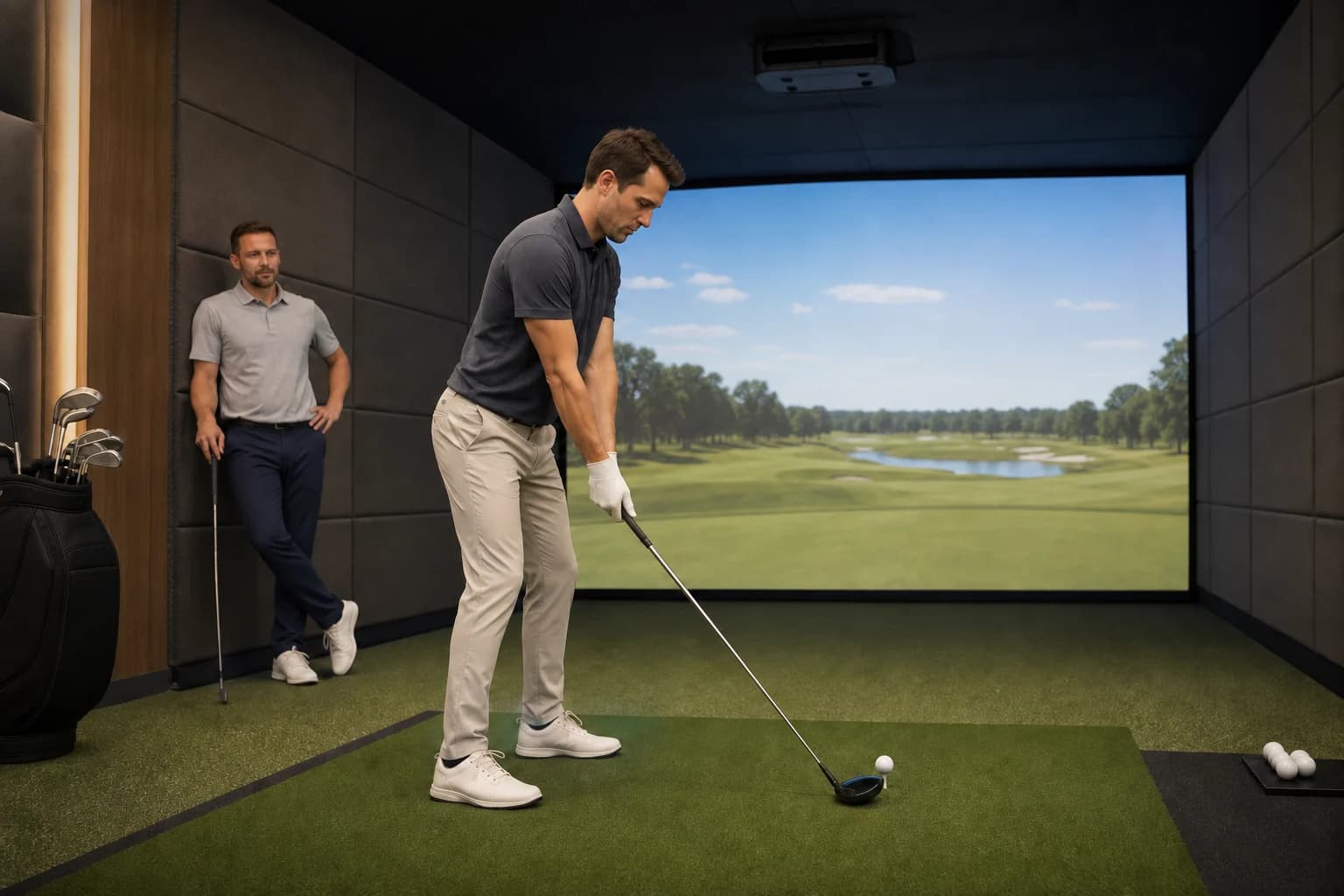
Yes—left-handed golfers can use golf simulators. But “left-handed compatible” and “easy for a mixed-handed group” are not always the same thing.
The launch monitor may support left-handed shots while the bay is too narrow for a comfortable left-handed driver swing. A floor-mounted unit may work after staff move it and change a setting. The simulator may be ready, but the venue may not have left-handed rental clubs.
If you are booking bay time, you do not need to become a launch-monitor expert. You need to confirm five practical details before you pay.
Quick Answer: The Five Checks
Ask the venue:
- Does this specific bay support left-handed full swings?
- Can right- and left-handed golfers switch without moving the launch monitor?
- Is the hitting position centered, with enough clearance on both sides?
- Do you have left-handed rental clubs in the size and flex needed?
- Does staff need advance notice to prepare the bay?
For a solo left-handed session, a bay that needs a one-time setup change may be perfectly fine. For a group alternating between right- and left-handed players, a fixed overhead or suitably positioned behind-player system is usually the smoother fit.
Start with GolfSimMap search, shortlist nearby venues, then call or message the venue if handedness is not stated on its listing.
Why Left-Handed Compatibility Varies by Bay
A simulator does not care about golf tradition. It measures what the club and ball do. The friction comes from the physical bay and the position of the tracking hardware.
Three setups are common.
| Bay setup | Left-handed use | Mixed-handed group flow | What to confirm |
|---|---|---|---|
| Fixed overhead monitor | Often supports both sides without moving the unit | Usually the simplest | Hitting-zone size and swing clearance |
| Monitor positioned behind the golfer | Can serve both sides when the bay is designed around a centered hitting area | Often smooth, but room depth and alignment still matter | Ball position, required markings, and staff setup |
| Portable camera unit beside the ball | May support either hand after repositioning and changing orientation | Can interrupt play if moved every turn | Who moves it, how it is aligned, and whether recalibration is needed |
This is why the useful question is not just, “What brand do you use?” It is, “How is that hardware installed in this bay?”
For example, Uneekor’s current overhead-monitor guidance says its front- and rear-mounted overhead units support right- and left-handed swings without repositioning. Trackman says its iO DUO configuration is designed to accommodate both hands in bays as narrow as 10 feet. That is a claim about that specific product configuration—not a guarantee that every Trackman venue or every 10-foot room will fit every golfer.
Portable floor units can also support left-handed golfers, but orientation may be part of the setup. The official Foresight GC3/GC3S manual documents a user-selected left-handed/right-handed device state controlled through the monitor display.
The decision point is simple: a compatible sensor is necessary, but the full bay still has to work.
What “Left-Handed Friendly” Should Mean at a Venue
A good left-handed bay should pass four real-world tests.
1. You can make a normal driver swing
The longest club is the best clearance test. A left-handed golfer should not have to shorten the backswing, stand unusually close to the ball, or worry about a wall, divider, table, or other player.
Do not rely on a photo that shows only a right-handed golfer. Ask whether left-handed players can make a full driver swing in the exact bay you will receive.
2. The ball can sit in a valid hitting zone
Launch monitors read shots only when the ball is placed inside their measurement area. In a narrow or offset bay, the technically valid ball position may leave a left-handed golfer without comfortable swing room.
If the venue says it “supports lefties,” follow with: “Is that from the normal hitting position, or do you move the mat or monitor?”
3. Staff can switch the system correctly
A poor first read is not proof that simulators do not work for left-handed golfers. The device may still be set to the previous player’s orientation, the ball may be outside the hitting zone, or the unit may need realignment after it is moved.
During your first few shots, check whether carry, start direction, and shot shape look plausible. If several normal strikes produce no reads or obviously strange results, stop and ask staff to verify the setup before you burn through paid time.
Our golf simulator putting accuracy guide explains the same principle for short shots: setup quality matters as much as the name on the hardware.
4. Left-handed clubs are actually available
Hardware compatibility does not guarantee equipment availability. Some venues provide left-handed sets, some offer them for a fee, and others stock only right-handed loaners.
Policies can be very specific. Perfect Shot Indoor Golf’s FAQ says it offers complete right- and left-handed rental sets. An X-Golf American Family Field event guide lists two left-handed flex options among its rentals. Those examples show what useful detail looks like; they do not establish a universal policy.
If you need a junior set, women’s set, particular shaft flex, or more than one left-handed set, ask before booking. “We have lefty clubs” may mean one adult set shared across the venue.
The Best Bay for a Mixed Left- and Right-Handed Group
For mixed-handed play, switching time matters more than it does during solo practice.
The smoothest bay is usually one where:
- The monitor stays fixed.
- The hitting area works from both sides.
- Each player’s handedness is saved correctly in the software.
- Bags, chairs, and loose clubs sit behind the safety line.
- The group can alternate normally without staff intervention.
An overhead setup often checks those boxes. Some behind-player systems can too. A side-mounted portable camera can still work, but repeatedly moving it may slow the round and introduce alignment mistakes.
If the venue has multiple bay types, ask for the one built for both hands—not merely the first bay available.
A better question for group bookings
Instead of asking, “Do you allow left-handed golfers?” say:
“We have two right-handed players and one left-handed player. Can we alternate every shot in the same bay without moving the launch monitor?”
That wording exposes the actual workflow.
If the answer is no, you still have options:
- Ask whether players can finish a hole in handedness groups to reduce moves.
- Book a second bay if the group is large enough.
- Choose a different bay with overhead tracking.
- Use one-time setup for a left-handed solo practice session.
A 60-Second Pre-Booking Script
Copy this into a call, email, or booking note:
Hi, I am a left-handed golfer and want to book a simulator bay. Does the specific bay support a full left-handed driver swing? If I play with right-handed golfers, can we switch every shot without moving or recalibrating the monitor? I also need a left-handed rental set—do you have one available for this booking?
That message is short, but it covers compatibility, clearance, group flow, and clubs.
If you are bringing your own set, use our first-time simulator checklist and indoor golf shoe guide before you leave.
What to Check When You Arrive
Do a quick bay inspection before the paid session gets busy.
Confirm the hitting side
Tell staff you are left-handed even if you added it to the booking note. Ask them to show you the valid ball position and any on-screen handedness setting.
Make one slow clearance swing
Without a ball, make a controlled driver swing. Check the wall, ceiling, divider, furniture, and people behind you. Never assume a bay is safe because a shorter right-handed player used it first.
Keep the waiting area clear
When hands alternate, the danger side changes. Put bags, drinks, and spectators behind the marked hitting area, not beside the mat.
Test three normal shots
Start with a mid-iron, not an all-out driver. Confirm that the unit reads the ball and that the output is directionally believable. Staff should fix repeated no-reads before you start a virtual round.
For a focused session after setup, follow the 60-minute golf simulator practice plan.
Red Flags Before You Book
Choose another bay or venue if:
- Staff cannot say whether the exact bay supports left-handed swings.
- The answer changes from “yes” to “only with short clubs.”
- A mixed group must move expensive hardware but no staff member will help.
- The venue cannot confirm a left-handed rental set you depend on.
- Photos show furniture or dividers tight to the left-handed swing side.
- The only assurance is “the software has a lefty setting.”
The last point matters. Software orientation cannot create physical clearance.
Venue policies genuinely differ. One facility may have dedicated or centered left-handed space, while another may ask left-handed players to contact staff before booking. That variability is visible in current venue guidance: OGP describes private rooms designed for left-handed play, while Hackney Links states that its current setup supports right-handed players only and asks left-handed golfers to make contact. Check the specific venue, not the general category.
How to Find a Left-Handed-Friendly Simulator Near You
Use GolfSimMap’s indoor golf search to build a shortlist. Then compare listing photos, hardware, venue type, and contact details.
If you are browsing a large market, start with state pages such as California indoor golf venues, Texas golf simulator venues, or New York indoor golf venues.
Hardware pages can narrow the research, but they are not a substitute for asking about the bay:
The best fit is the venue that confirms your full swing, your group’s switching flow, and your club needs before taking the reservation.
Frequently Asked Questions
Can left-handed golfers use any golf simulator?
Not every installed bay. Many launch monitors support left-handed shots, but the room layout, hitting-zone position, monitor placement, and software setup also have to work. Confirm the exact bay before booking.
Do golf simulators need a left-handed setting?
Some devices or software profiles use a handedness setting; others work from a fixed measurement area without a per-shot hardware move. Ask staff to confirm the correct player orientation and ball position.
What simulator setup is easiest for left- and right-handed players together?
A fixed overhead monitor with a centered, two-sided hitting area is often the easiest because the hardware can stay in place. Some systems positioned behind the golfer also support smooth switching when the bay is designed for it.
Do indoor golf venues provide left-handed clubs?
Some do, but availability is venue-specific. Confirm the number of sets, player size, shaft flex, rental fee, and whether the set can be reserved for your time slot.
Does left-handed simulator golf produce less accurate data?
Handedness alone should not be treated as a reason for bad data. Repeated no-reads or implausible results can point to the wrong orientation, poor ball placement, restricted clearance, or a moved monitor that needs staff attention.
The Bottom Line
Left-handed golfers can get a full, useful simulator session. The mistake is treating a generic “yes” as enough.
Confirm the specific bay, the switching process, swing clearance, and rental-club availability. Then arrive early enough to test the setup before starting the clock in earnest.
Find an indoor golf simulator near you, shortlist two or three venues, and send the 60-second booking message above. A quick check now is better than discovering a right-handed-only room with a paid hour already running.
Related Articles
Join a Golf Simulator League Without a Team: Solo Guide
Join a golf simulator league without a team: compare free-agent placement, solo leagues, schedules, fees, and beginner support before you register.
ReadGolf Simulator Distance Shorter Than Outside? 7 Checks
Golf simulator distance shorter than outside? Use this 10-shot test to separate carry, swing, settings, ball, mat, and bay-setup problems.
ReadHow Many People Can Play a Golf Simulator? Group Guide
Most golf simulator bays work best with one to four players. Learn when to book extra time, use team formats, or reserve a second bay for your group.
Read